Adverb vs Advarb: Complete Guide with Definition, Types, and Examples
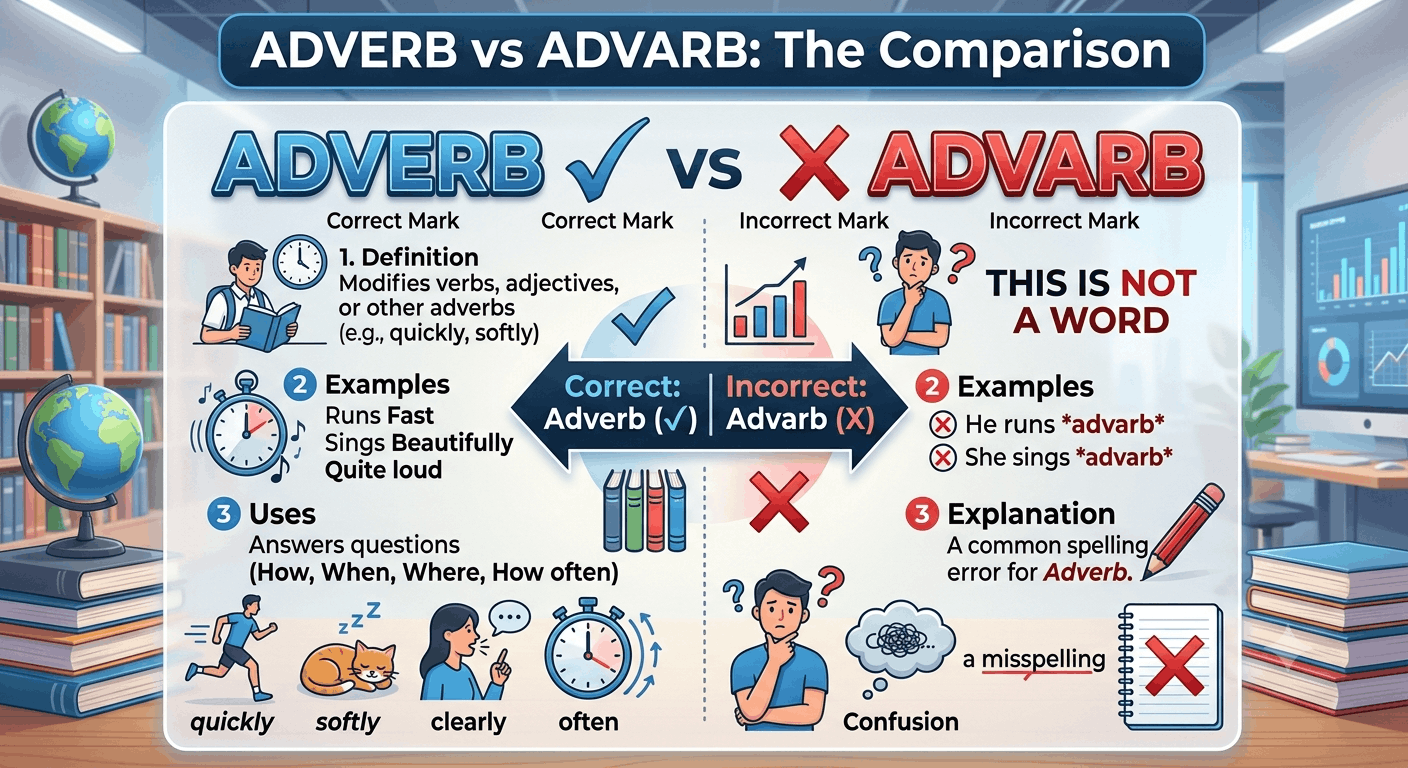
If you have ever typed “advarb” into a search bar and wondered whether it means something different from “adverb,” you are not alone. Thousands of people search for advarb every month, but here is the simple truth: advarb is not a real English word — it is a common misspelling of “adverb.” This confusion is completely understandable, especially for English language learners, students, and even native speakers who type quickly without noticing the swapped letters.
In this comprehensive guide, we will clear up the “adverb vs advarb” confusion once and for all, and then dive deep into everything you need to know about adverbs — what is an adverb, adverb definition, adverb meaning, adverb examples, adverb clause, adverb phrase, conjunctive adverbs, and the difference between adverbs and adjectives. By the end, you will not only know the correct spelling but also understand adverbs so well that you can identify, use, and teach them with confidence.
What is an Adverb? (Definition and Meaning)
So, what is an adverb? In the simplest terms, an adverb is a word that modifies or describes a verb, an adjective, another adverb, or even an entire sentence. The adverb meaning essentially revolves around adding extra information — telling us how, when, where, why, how often, or to what degree something happens.
Adverb definition (formal): An adverb is a part of speech that modifies a verb, adjective, or another adverb, expressing manner, place, time, frequency, degree, or certainty.
If someone asks you “what’s an adverb” or “whats a adverb” in casual conversation, the easiest way to explain it is this: adjectives describe nouns, but adverbs describe almost everything else — actions, qualities, and even other descriptive words.
Quick Example to Understand Adverb Meaning
- She sings beautifully. (describes the verb “sings”)
- He is extremely talented. (describes the adjective “talented”)
- They finished the race very quickly. (describes another adverb “quickly”)
Now that we’ve answered “what is a adverb” at a basic level, let’s look at how to actually identify one in a sentence.
Noun, Verb, Adjective, Adverb: Understanding Parts of Speech
Before we go further into adverb types, it helps to see where adverbs fit among the basic building blocks of English: noun, verb, adjective, adverb (sometimes written as verb noun adjective adverb).
- Noun – names a person, place, thing, or idea (e.g., dog, city, happiness)
- Verb – shows an action or state of being (e.g., run, is, think)
- Adjective – describes a noun (e.g., beautiful, tall, red)
- Adverb – describes a verb, adjective, or another adverb (e.g., quickly, very, well)
Understanding this framework makes it much easier to answer questions like “is fast an adverb” or “is very an adverb” — which we’ll tackle shortly.
Types of Adverbs (With Examples)
When people search for adverb examples, examples of adverbs, or some examples of adverb, they usually want to see the different categories in action. Adverbs generally fall into five major types.
1. Adverbs of Manner
These describe how an action happens. Most adverbs of manner end in -ly.
Examples: quickly, slowly, carefully, softly, loudly, happily, quietly, gracefully
Example sentence: She is crying loudly. (Here, “loudly” is an adverb of manner explaining how she is crying — a very common search query is “she is crying adverbs” or “she is crying loudly adverbs,” and this is exactly the type it belongs to.)
Other examples: “quickly, friendly, softly” — though it’s worth noting that not every word ending in -ly is an adverb (more on that in the adjective vs. adverb section below).
2. Adverbs of Place
These tell us where an action happens.
Examples: here, there, everywhere, nearby, outside, inside, upstairs, abroad
Example sentence: The children played outside.
3. Adverbs of Time
These tell us when something happens.
Examples: now, then, yesterday, soon, later, tomorrow, already, recently
Example sentence: We will leave tomorrow.
4. Adverbs of Frequency
Adverbs of frequency tell us how often something happens. This is one of the most searched categories, often written as “adverbs of the time” or “adverbs and frequency.”
Examples: always, usually, often, sometimes, rarely, never, occasionally, frequently
Example sentence: Is “always” an adverb? Yes — in the sentence “He always arrives on time,” “always” is an adverb of frequency describing how often he arrives on time.
5. Adverbs of Degree
These tell us to what extent or how much.
Examples: very, too, quite, extremely, almost, barely, hardly, completely
Example sentence: Is “extremely” an adverb? Yes — in “The weather is extremely cold,” “extremely” intensifies the adjective “cold,” making it a degree adverb.
The Complete List of Adverbs (Adverb List)
Because so many learners search for a simple adverb list or list of adverbs, here is a categorized reference:
Manner: carefully, badly, well, fast, hard, quickly, slowly, gently, calmly Place: here, there, everywhere, somewhere, nowhere, home, abroad Time: today, yesterday, soon, immediately, already, still, yet Frequency: always, never, sometimes, often, rarely, seldom, usually Degree: very, too, so, quite, rather, almost, enough
Adverbs Ending in -LY (LY Adverbs List)
One of the most common questions is about adverbs using ly or an ly adverbs list. While not all adverbs end in -ly, and not all -ly words are adverbs, a huge portion of manner adverbs are formed by adding “-ly” to an adjective.
Formula: Adjective + “-ly” = Adverb
Examples:
- quick → quickly
- careful → carefully
- happy → happily
- soft → softly
- honest → honestly
- rapid → rapidly
- calm → calmly
- serious → seriously
Important exception: Words like “friendly,” “lovely,” “lonely,” and “silly” end in -ly but are actually adjectives, not adverbs. This is exactly why the search term “quickly friendly softly not adverbs” comes up — people are trying to figure out which -ly words are true adverbs. The rule of thumb: check whether the word describes a noun (adjective) or a verb/adjective/adverb (adverb).
Adverb vs Adjective: What’s the Real Difference?
This is one of the most searched comparisons alongside “adverb vs advarb” — people constantly want to know adjective vs adverb, adverb vs adjective, or simply adj adverb differences.
| Feature | Adjective | Adverb |
|---|---|---|
| What it modifies | Nouns and pronouns | Verbs, adjectives, other adverbs |
| Common question answered | What kind? Which one? How many? | How? When? Where? How often? To what extent? |
| Example | She is a quick runner. | She runs quickly. |
| Position | Usually before a noun | Usually after a verb or before an adjective |
Adjectives vs Adverbs: Example Sentences
- Adjective: He is a careful driver. (describes the noun “driver”)
- Adverb: He drives carefully. (describes the verb “drives”)
- Adjective: That was a good performance.
- Adverb: She performed well. (Note: “well” is the adverb form of “good,” not “goodly.”)
Is “Fast” an Adverb?
Yes — and this is a tricky one. “Fast” can function as both an adjective and an adverb without changing form.
- Adjective: He is a fast runner.
- Adverb: He runs fast.
Is “Quickly” an Adverb?
Yes, “quickly” is always an adverb of manner, formed from the adjective “quick” + “-ly.”
Is “Be” an Adverb?
No. “Be” is a verb (specifically a linking/auxiliary verb), not an adverb. This is a common point of confusion for beginners.
Adverb Clause: Definition and Examples
An adverb clause (also searched as adverb clauses) is a group of words that contains a subject and a verb and functions as an adverb within a sentence. It modifies a verb, adjective, or another adverb, just like a single-word adverb does — but it’s a full clause.
Structure: Subordinating conjunction + Subject + Verb
Examples of adverb clauses:
- Because it was raining, we stayed indoors. (tells why)
- She left before the meeting started. (tells when)
- Wherever you go, I will follow. (tells where)
- He acted as if he owned the place. (tells how)
Common subordinating conjunctions that introduce adverb clauses include: because, since, although, if, when, while, unless, before, after, as, though.
Adverb Phrase: Definition and Examples
An adverb phrase (or adverb of phrase, as some search it) is a group of two or more words that work together to modify a verb, adjective, or adverb — but unlike a clause, it does not contain both a subject and a verb.
Examples of adverb phrases:
- She sang in a beautiful voice. (“in a beautiful voice” modifies “sang”)
- He arrived just in time. (“just in time” modifies “arrived”)
- They walked very slowly. (“very slowly” modifies “walked”)
Conjunctive Adverbs (Connecting Adverbs)
A conjunctive adverb — also searched as conjunctive adverbs, conjuctive adverb, coordinating adverb, or connecting adverbs — is a special type of adverb that connects two independent clauses while also showing the relationship between them (such as contrast, cause, addition, or sequence).
Conjunctive Adverbs List
however, therefore, moreover, furthermore, nevertheless, consequently, meanwhile, otherwise, thus, hence, accordingly, similarly, indeed, instead, subsequently, nonetheless
Conjunctive Adverb Examples in Sentences
- I wanted to go for a walk; however, it started raining.
- She studied hard; therefore, she passed the exam.
- He forgot his wallet; consequently, he couldn’t pay for lunch.
- The team practiced daily; moreover, they hired a new coach.
Notice the punctuation pattern: semicolon + conjunctive adverb + comma when joining two independent clauses. This is one of the most important grammar rules connected to adverbs and conjunctions.
Adverbs and Conjunctions: How They Differ
People often search adverbs and conjunctions together because conjunctive adverbs sit right at the intersection of the two categories. True conjunctions (like “and,” “but,” “or,” “because”) only connect clauses and don’t carry independent meaning of their own the way adverbs do. Conjunctive adverbs, on the other hand, do carry meaning (they show relationship — contrast, result, addition) while also linking ideas, which is why they are classified as adverbs, not conjunctions.
Adverbs of Degree, Quantity, and Other Special Categories
Some searches specifically look for adverb of degree or quantity. These are the same as adverbs of degree mentioned earlier — words like very, too, extremely, almost, quite, barely, and completely — which show intensity or amount.
There’s also a category sometimes called relative adverbs (searched as adverb relative), which include words like “where,” “when,” and “why” when they introduce a relative clause.
Example: This is the house where I grew up.
Adverb Form of Common Words
A frequent search is the “adverb form of defense.” The noun “defense” becomes the adjective “defensive,” and the adverb form is “defensively.”
Example sentence: The goalkeeper reacted defensively to the sudden attack.
Similarly:
- integrity (noun) → the adverb form would typically use a related adjective like “upright” → “uprightly,” since “integrity” itself doesn’t have a direct adverb form.
- eager (adjective) → eagerly (adverb) — this answers the search “eagerly which adverb”: eagerly is an adverb of manner.
- place (noun/verb) → adverbs of place (like here, there, everywhere) are a separate category, not a direct adverb form of the word “place.”
Adverbs in Spanish
For language learners searching adverbs in Spanish or Spanish adverbs, the good news is that Spanish adverbs work similarly to English ones. Many Spanish adverbs are formed by adding “-mente” to the feminine form of an adjective — just like English adds “-ly.”
Examples:
- rápida (quick) → rápidamente (quickly)
- lenta (slow) → lentamente (slowly)
- fácil (easy) → fácilmente (easily)
Common Spanish adverbs (not ending in -mente) include: bien (well), mal (badly), mucho (a lot), poco (a little), siempre (always), nunca (never), aquí (here), allí (there).
Awry: Is It an Adverb?
A more advanced vocabulary search is “awry adverb.” Yes, “awry” is an adverb (and can also function as an adjective) meaning “away from the expected course; amiss.”
Example: Their carefully laid plans went awry.
500 Verbs and Adverbs: Building Your Vocabulary
Language learners sometimes search for resources like “500 verbs and 1000 adverbs” to expand their vocabulary systematically. While memorizing exact numbers isn’t necessary, a strong approach is to:
- Learn common verbs first (run, eat, speak, write, think)
- Pair each verb with an adverb of manner (run quickly, eat slowly, speak clearly, write neatly, think carefully)
- Practice adverbs of frequency with everyday verbs (I usually eat breakfast; She rarely complains)
- Build sentences combining multiple adverb types
This layered approach helps learners internalize both adverbs list vocabulary and correct sentence structure simultaneously.
Common Sentences Using Adverbs
To reinforce everything, here are several sentences using adverb correctly across different categories:
- He spoke softly so as not to wake the baby. (manner)
- They will meet tomorrow morning. (time)
- She always double-checks her work. (frequency)
- The cat hid somewhere in the garden. (place)
- The soup was too hot to eat. (degree)
- Honestly, I don’t know the answer. (sentence adverb, showing attitude)
- He eagerly accepted the job offer. (manner)
- We arrived just in time for the show. (adverb phrase)
Adverb vs Advarb: Final Clarification
Let’s circle back to where we started. If you search “adverb adverb”, “advarb”, or type it as “adverb adverb sentences” by mistake, remember:
- ✅ Correct spelling: Adverb
- ❌ Incorrect spelling: Advarb
There is no separate grammatical category called “advarb.” It is simply a typo or phonetic misspelling of “adverb,” likely because the “e” and “a” sounds can blend together in casual pronunciation or fast typing. Whenever you see “advarb” in a search result or a piece of writing, mentally correct it to “adverb,” and everything else in this article applies fully.
Conclusion
Adverbs are one of the most versatile and essential parts of speech in English grammar. From describing how an action happens (adverbs of manner) to when (adverbs of time), where (adverbs of place), how often (adverbs of frequency), and to what degree (adverbs of degree), adverbs add depth, clarity, and precision to our sentences. Understanding the difference between adjectives and adverbs, recognizing adverb clauses and adverb phrases, and mastering conjunctive adverbs will significantly improve both your spoken and written English.
And the next time you’re tempted to type “advarb” into a search engine, you’ll know exactly why the correct word is adverb — and you’ll have a complete, research-backed understanding of everything that word represents.