Specialty vs Speciality: The Complete Guide to Meaning, Spelling, Pronunciation, and Usage
If you’ve ever paused mid-sentence wondering whether to write specialty or speciality, you’re not alone. This is one of the most searched spelling questions in the English language, and for good reason — both words look almost identical, sound similar, and mean the same thing. Yet dictionaries list them separately, style guides treat them differently, and depending on where your reader lives, one spelling might look completely normal while the other looks like a typo.
This guide breaks down everything you need to know: the core difference between specialty and speciality, their shared meaning, correct pronunciation, regional usage across the US, UK, Canada, and Australia, how they relate to words like specialization and specialism, their plural forms, and how each is used in real-world contexts like medicine, coffee culture, and cooking. By the end, you’ll never have to second-guess this spelling again.
Quick Answer: What’s the Difference Between Specialty and Speciality?
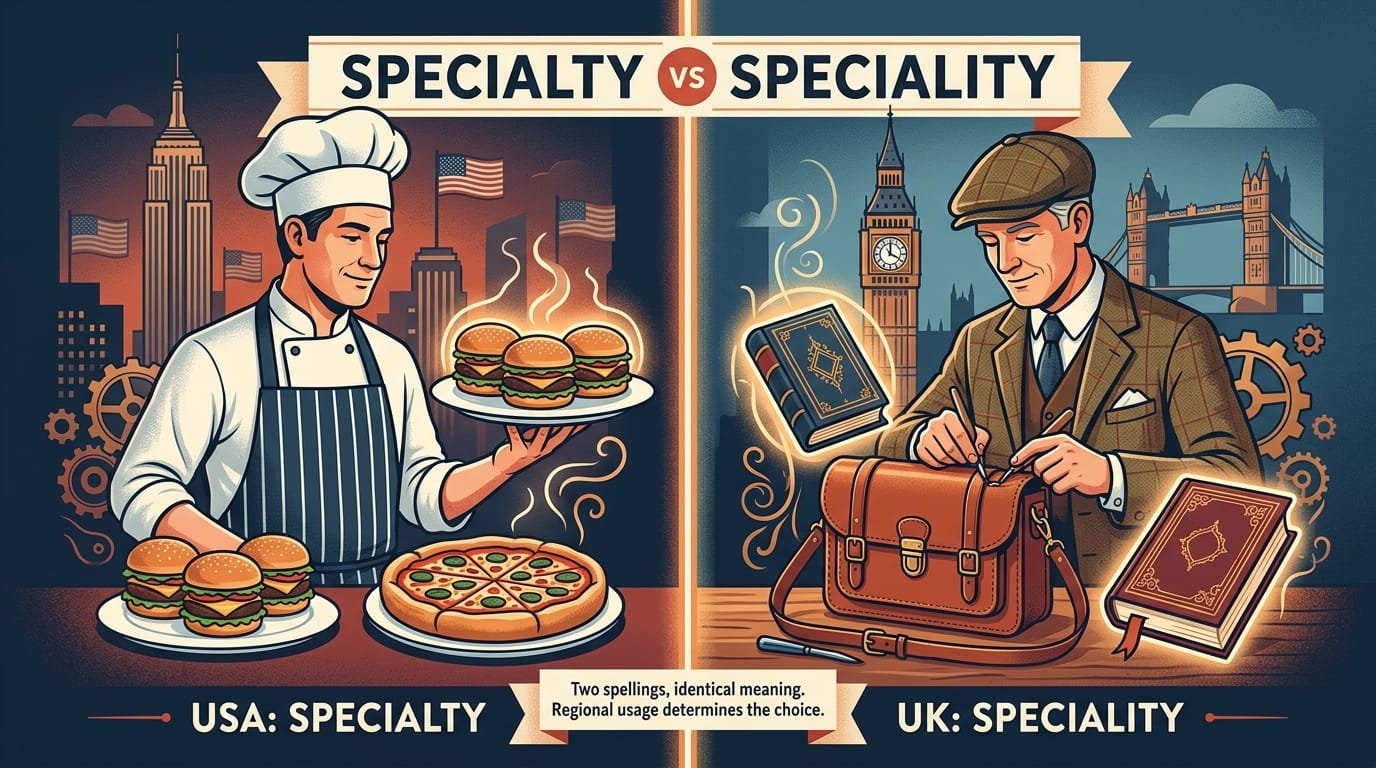
In short: there is no difference in meaning. The difference is purely regional spelling.
- Specialty is the standard spelling in American English, Canadian English, and Australian English.
- Speciality is the standard spelling in British English.
Both words refer to the same idea — a particular skill, area of expertise, product, or field that someone or something is known for. Neither spelling is “more correct” than the other in an absolute sense. The correct choice simply depends on which English-speaking audience you’re writing for.
Specialty vs Speciality: Meaning
Before diving into regional differences, it helps to understand what the word actually means, since both spellings share this same core definition.
Specialty / speciality (noun) refers to:
- A particular subject, skill, or area of activity in which a person, business, or institution has developed expertise. Example: Cardiology is her specialty.
- A product, dish, or service that a place or business is especially known for. Example: Seafood pasta is the restaurant’s speciality.
- Something distinctive or characteristic of a person, place, or thing.
According to Merriam-Webster’s dictionary entry, <cite index=”7-1″>the word traces back to Middle English “specialte,” from Anglo-French “especialté,” from Late Latin “specialitas,” ultimately derived from the Latin “specialis,” meaning “special.”</cite> Both spellings evolved from this same Latin-French root, which is precisely why they carry identical meanings today — they are, quite literally, the same word wearing two different regional outfits.
So whether you’re describing a doctor’s field of medicine, a chef’s signature dish, or a company’s main line of business, both “specialty” and “speciality” say exactly the same thing. The only question is which spelling fits your audience.
Specialty vs Speciality: Origin and History
The history of these two spellings is genuinely interesting, because it isn’t simply a case of American English inventing a new form. According to language reference sites, <cite index=”4-1″>speciality was actually the more common spelling in British English for roughly a hundred years, spanning the mid-19th century through the mid-20th century</cite>, functioning as a straightforward alternative form of “specialty.”
Over time, though, usage patterns diverged by region:
- In the United States, “specialty” became overwhelmingly dominant, following a broader pattern in American English of trimming down longer Latin-derived word endings (something Noah Webster and other 19th-century American lexicographers actively encouraged as part of simplifying American spelling conventions).
- In the United Kingdom, “speciality” held on as the preferred form, preserving the fuller, more traditional Latin-influenced spelling.
Interestingly, usage data shows the two forms have actually swapped positions with each other more than once in British English since the 1970s, with speciality and specialty alternating in popularity within the UK even though speciality has remained the more “correct” or standard form in formal British writing. This tells you something important: even native British speakers occasionally use “specialty,” and it isn’t automatically treated as wrong — just less standard.
Specialty vs Speciality: US vs UK vs Canada vs Australia
This is where things get genuinely useful for writers, students, and professionals. Regional convention is the single biggest factor in choosing between these two spellings.
Specialty vs Speciality in the US
In American English, “specialty” is the only accepted standard spelling. You will see it in newspapers, academic journals, medical documentation, business writing, and everyday conversation. “Speciality” would look distinctly foreign or old-fashioned to an American reader.
Example: “Her specialty is pediatric cardiology, and she’s built an excellent reputation at the hospital.”
Speciality vs Specialty in the UK
British English strongly favors “speciality,” especially in formal, academic, and professional contexts. UK newspapers, the NHS, and British universities consistently use this form.
Example: “Cardiology is her speciality in the NHS.”
That said, because global media, American software autocorrect, and international business writing are saturated with the American spelling, “specialty” does occasionally creep into British informal writing — but it remains non-standard there.
Speciality vs Specialty in Canada and Australia
This is the part that surprises many people. You might expect Canada and Australia — both of which generally lean toward British spelling conventions (think “colour,” “centre,” “organise”) — to also prefer “speciality.” They don’t. According to language references, <cite index=”2-1″>specialty is the standard spelling in American, Canadian, and Australian English, which is somewhat unusual given that Australian English typically follows British spelling rules in most other cases</cite>.
So if you’re writing for a Canadian or Australian audience, “specialty” is generally the safer, more expected choice — even though these countries otherwise favor British spelling in most other word categories.
A Simple Regional Cheat Sheet
| Region | Preferred Spelling |
|---|---|
| United States | Specialty |
| Canada | Specialty |
| Australia | Specialty |
| United Kingdom | Speciality |
| Formal/International Academic Writing | Either, but stay consistent |
The most important rule, regardless of region: pick one spelling and use it consistently throughout your entire document. Switching between “specialty” and “speciality” in the same article, resume, or academic paper looks careless and unprofessional, even though both are technically valid words.
Specialty vs Speciality: Pronunciation
Here’s something many people don’t realize — these two words aren’t just spelled differently, they’re also pronounced differently, because speciality has an extra syllable.
- Specialty is pronounced with three syllables: /ˈspɛʃ.əl.ti/ — “SPESH-uhl-tee.”
- Speciality is pronounced with five syllables: /ˌspɛʃ.iˈæl.ə.ti/ — “spesh-ee-AL-uh-tee.”
This is a meaningful distinction if you’re practicing spoken English. “Specialty” flows quickly, almost as a compressed word, while “speciality” has that middle “-ee-AL-” stress that stretches it out. If you’re an English learner trying to sound natural in American versus British contexts, getting this pronunciation difference right is just as important as getting the spelling right, since mispronouncing one as the other can sound noticeably off to native speakers.
Specialty vs Speciality vs Specialization vs Specialism
This is where confusion tends to multiply, because English actually has a small family of related words that all orbit the idea of “expertise” or “focus,” but they aren’t perfectly interchangeable.
Specialty / Speciality
Refers to the specific area itself — the field, skill, or product a person or business is known for. It’s a noun describing “the thing you’re known for.”
Example: Neurology is his specialty.
Specialization
Refers to the process or act of focusing on and developing expertise in a particular area. It’s more about the ongoing pursuit or training, though it’s often used to describe the resulting field too.
Example: Her specialization in machine learning took years of doctoral research.
In casual usage, “specialty” and “specialization” often overlap — both can describe someone’s field. But strictly speaking, specialization leans toward the process of narrowing focus, while specialty leans toward the established area of expertise itself.
Specialism
“Specialism” is mostly a British English term, used especially in education and academic contexts to describe a particular branch of study or professional focus, often within teaching or academia.
Example: Her specialism at university was medieval literature.
“Specialism” is less common in American English, where “specialty” or “specialization” would typically be used instead in the same context.
Specialized
This is the adjective form, describing something that has been designed, trained, or developed for a specific, narrow purpose.
Example: This is specialized equipment used only in cardiac surgery.
So, in short: specialty/speciality is the noun for the field itself, specialization is the noun for the process (or sometimes the field), specialism is the British academic variant, and specialized is the adjective.
Specialties vs Specialities: Plural Forms
Both words pluralize regularly, following standard English rules for words ending in “-ty”:
- Specialty → Specialties (American, Canadian, Australian English)
- Speciality → Specialities (British English)
Example (US): “The hospital offers a wide range of medical specialties, from oncology to orthopedics.”
Example (UK): “The hospital offers a wide range of medical specialities, from oncology to orthopaedics.”
The same regional rule that governs the singular form governs the plural — there’s no additional complexity here. If you’re using “specialty” throughout your writing, simply pluralize it as “specialties.” If you’re using “speciality,” pluralize it as “specialities.”
Medical Specialty vs Medical Speciality
This is one of the most common real-world contexts where the specialty/speciality debate comes up, since medicine is a field built entirely around areas of expertise.
In American medical writing, journals, hospital documentation, and everyday conversation, “medical specialty” is used almost universally. You’ll see phrases like “choosing a medical specialty,” “specialty care,” and “board-certified in his specialty.”
In British and Commonwealth medical contexts (though, notably, not in Canada or Australia, which lean American here), “medical speciality” is the standard form, as seen in NHS documentation and British medical journals. A useful example from a British legal case: <cite index=”3-1″>a spokesperson once clarified that a particular doctor was not certified in any medical speciality at the time of a patient’s death</cite> — a sentence that illustrates just how naturally British writers use “speciality” in formal, even legal and clinical, contexts.
If you’re writing medical content, the deciding factor should always be your target audience: American healthcare platforms should use “specialty,” while British or NHS-facing content should use “speciality.”
Chef’s Special vs Chef’s Specialty
Restaurant menus introduce a slightly different wrinkle, because there’s actually a third related term in play here: “special.”
- Chef’s special refers to a one-off or limited-time dish — something the chef is offering today, this week, or for a limited period, often not part of the regular menu.
- Chef’s specialty refers to a dish the chef (or restaurant) is famous for — a permanent, signature item that represents their expertise, regardless of when you visit.
So if a server says, “Today’s chef’s special is a truffle risotto,” that dish might disappear from the menu next week. But if they say, “The chef’s specialty is his slow-braised short ribs,” that’s implying it’s a standing signature dish central to the restaurant’s identity.
Understanding this distinction matters for food writers, restaurant marketers, and menu designers — mixing up “special” and “specialty” can unintentionally suggest a permanent dish is only temporary, or vice versa.
Speciality Coffee vs Specialty Coffee
The coffee industry offers another interesting case study. Globally, the coffee trade actually has an official, standardized use of these terms tied to quality grading, not just regional spelling preference.
- Specialty coffee is the term used by the Specialty Coffee Association (SCA), based in the US, and is the globally dominant term used in the coffee trade to describe high-quality, high-scoring coffee beans (typically 80+ points on the SCA’s 100-point cupping scale).
- Speciality coffee appears in UK-based coffee writing and branding, referring to the same quality tier, just using the British spelling convention.
So in this niche, the spelling choice isn’t just about American versus British audiences in general prose — it can also reflect which industry body or regional coffee scene a brand is aligning itself with. Many UK specialty coffee roasters still use “specialty” in their branding specifically because it’s the internationally recognized industry term, showing how global commercial standardization can sometimes override typical regional spelling rules.
Speciality Doctor: A UK-Specific Term
Worth noting separately: in the UK’s National Health Service career structure, “Speciality Doctor” is an official job title and grade for a qualified, experienced physician who works within a specific medical specialty but sits outside the traditional consultant training pathway. This is a fixed, formal title — you wouldn’t see “Specialty Doctor” used as an official NHS grade, since the term is embedded in British healthcare terminology specifically using the British spelling.
Common Misspellings of Specialty and Speciality
Because these words combine a tricky consonant cluster with an unusual “-ty/-lity” ending, they’re frequently misspelled. If you’ve ever typed the word and had it underlined in red, you’re in good company. Common incorrect spellings include:
specilty, especialty, specalty, specilaty, speciatly, speacilty, specality, soecialty, spealty, speclity, specilaity, speicalty, speacialty, speciallty, speacilty, specailty, speacility, specility, specialtiy, specaility
None of these forms are considered correct in any standard English dictionary. If you’re unsure how to spell it, a simple memory trick helps: “specialty” has the same core letters as “special” plus “-ty,” while “speciality” keeps the full “-ality” ending, just like “reality” or “personality.” If you can spell “special” and “reality” correctly, you already have both forms covered.
How to Remember the Difference: A Quick Mnemonic
Here’s a simple trick that many English learners find useful:
- Specialty = Short + American. Think “USA is quick and efficient” — the shorter word matches the shorter spelling convention.
- Speciality = Long + British. Think “UK keeps tradition” — the longer, more traditional Latin-based ending matches Britain’s tendency to preserve older spelling forms (similar to how the UK keeps “colour,” “favourite,” and “centre” instead of the trimmed American versions).
Another helpful anchor: speciality rhymes with words like “personality,” “reality,” and “formality” — all of which are standard across both American and British English without any spelling variation, which can help you remember that speciality’s extra “-al-” syllable isn’t a mistake, it’s a legitimate, older form of the word.
Specialty vs Speciality: Synonyms
Depending on context, both words share several useful synonyms that can add variety to your writing:
- Expertise — general knowledge or skill in a particular field
- Forte — something a person does particularly well
- Métier — a person’s trade, profession, or particular area of skill
- Niche — a specialized segment or area, often used in business or marketing contexts
- Field — a general area of activity or study
- Strong suit — an informal way to describe what someone excels at
- Signature dish/item — specifically for restaurant or product contexts
Antonyms, meanwhile, might include terms like “generalist,” “general practice,” or “all-rounder” — describing broad competence across many areas rather than deep focus in one.
Sample Sentences Using Specialty and Speciality
To cement the difference, here are paired examples showing the same sentence written in both American and British style:
American (Specialty):
- “This bakery’s specialty is sourdough bread baked fresh every morning.”
- “He completed his residency and chose orthopedic surgery as his specialty.”
- “The store sells specialty items you won’t find anywhere else in town.”
- “Digital marketing is her professional specialty.”
British (Speciality):
- “This bakery’s speciality is sourdough bread baked fresh every morning.”
- “He completed his training and chose orthopaedic surgery as his speciality.”
- “The shop sells speciality items you won’t find anywhere else in town.”
- “Digital marketing is her professional speciality.”
Notice how, aside from the spelling itself, absolutely nothing about the sentence structure or meaning changes. This reinforces the central point of this entire guide: the difference between specialty and speciality is orthographic, not semantic.
Why This Distinction Matters for Writers and Businesses
You might wonder why such a small spelling variation deserves this much attention. The answer comes down to audience trust and professionalism. If a business based in London writes “specialty” throughout its website, American readers won’t notice anything unusual — but British readers might perceive the copy as slightly off, possibly assuming the brand isn’t local or doesn’t understand its own market. The reverse is equally true: an American company using “speciality” throughout its marketing may come across as oddly formal, foreign, or simply inconsistent with typical US branding conventions.
For SEO purposes, search intent also matters. People searching “speciality coffee shop near me” in London have a different underlying regional context than someone searching “specialty coffee shop near me” in Chicago — even though they’re looking for functionally the same thing. Writers, marketers, and businesses that understand this nuance can tailor content more precisely to their audience’s expectations, both linguistically and in terms of search visibility.
Final Verdict: Specialty or Speciality — Which Should You Use?
There’s no universally “correct” answer — only a regionally correct one:
- Writing for American, Canadian, or Australian readers? Use specialty (and specialties for the plural).
- Writing for British or UK-based readers, especially in formal, academic, or medical contexts? Use speciality (and specialities for the plural).
- Writing for an international or mixed audience? Either is acceptable, but pick one spelling and stay consistent throughout the entire piece.
Ultimately, both words carry the exact same weight, meaning, and usefulness — they’re simply two regional dialects of the same idea: something a person, place, or thing is uniquely and expertly known for. Master this distinction, and you’ll never again hesitate over which spelling to use, no matter which side of the Atlantic your reader is on.
Frequently Asked Questions
Is “speciality” a real word?
Yes. It is a fully standard word in British English, not a misspelling of “specialty.” Both forms appear in major dictionaries.
Which spelling does Merriam-Webster use?
Merriam-Webster, an American dictionary, lists “specialty” as the primary headword, since it’s the standard American form.
Do specialty and speciality mean different things?
No. Their meanings are identical. Only the spelling (and pronunciation) differ by region.
Is it “specialities” or “specialties”?
Both are correct, depending on which base spelling you’re using: “specialities” pairs with “speciality” (British), and “specialties” pairs with “specialty” (American).
How do you pronounce speciality?
It’s pronounced with five syllables: spesh-ee-AL-uh-tee, compared to the three-syllable “SPESH-uhl-tee” for specialty.
Can I use both spellings in the same document?
It’s best not to. Even though both are valid words, mixing them within a single piece of writing looks inconsistent. Choose one based on your audience and stick with it.