Fav vs Fave: The Complete Grammar Guide to “Favorite” Abbreviations
If you have ever typed “this is my fav song” and then wondered whether it should have been “my fave song,” you are not alone. Both spellings show up constantly across social media captions, texting, app buttons, and casual writing — yet almost no style guide gives a clear, confident answer about which one is “correct.” The truth is that fav and fave are not competing rules; they are two different informal shortenings of the same word: favorite (or favourite in British English).
This guide breaks down the grammar, history, and real-world usage of fav and fave in detail — where each word came from, how they function as nouns and adjectives, when to use favs versus faves as a plural, and how each behaves differently depending on the platform (texting, social media, app UI, branding). It also clears up a related but separate source of confusion: words like fava beans, Faver Dykes State Park, and brand names such as Popeyes’ $5 Faves menu, which sound similar but have nothing to do with the abbreviation of “favorite.”
By the end, you will know exactly which form fits a sentence, a caption, a button label, or a formal document — and why.
Where “Favorite” Comes From
Before comparing the abbreviations, it helps to understand the parent word. Favorite traces back to the Latin favor (“goodwill, support, preference”), which passed through Old French favorit and Italian/Spanish/Portuguese favorito before entering English. The British spelling favourite added the “u” as part of a broader pattern (seen in words like colour and honour) that some scholars link to French orthographic influence, though the exact reasoning is debated among linguists. American English later dropped the “u,” giving us the favorite/favourite split that still exists today — a split that has nothing to do with fav vs fave, but explains why some sources treat the two abbreviation forms as regional variants when they are not.
What Does “Fav” Mean?
Fav is a clipped, informal abbreviation of favorite. It drops the ending entirely, keeping only the first syllable. Historically, fav (often written with a period, fav.) appeared in print by 1935, originally in horse racing terminology, where it referred to “the projected winner of a race” — what bettors would call the favorite. From there it spread into everyday informal writing.
Today, fav is most associated with:
- Digital interfaces: buttons, tags, and menu labels where space is limited (e.g., “Add to fav,” a fav icon, a heart or star toggle).
- Social media shorthand: the term stuck around from the early Twitter era, when “favoriting” a tweet was casually shortened to “fav.” You may still see references to the old “save the fav” debate from when Twitter changed the star icon to a heart (the “like” button).
- Texting and captions: “this is my fav” reads as quick, casual, and slightly clipped — appropriate for fast, informal exchanges.
Grammatically, fav functions as both a noun (“She’s my fav”) and an adjective (“my fav show”), exactly mirroring how favorite itself works in casual English.
What Does “Fave” Meaning Add?
Fave is the other common shortening of favorite, and it is generally considered the more “finished-looking” of the two because it keeps the long vowel sound spelled out phonetically — the silent “e” signals that the word is pronounced “fayv,” matching the way favorite is actually said. Dictionary sources date fave to at least 1938, when it appeared in Variety magazine, and it was originally used mainly in show-business writing — describing a favorite performer, act, or nominee — before broadening into general slang.
Merriam-Webster now lists fave as a standard informal entry (adjective and noun, first known use 1938), which gives it slightly more dictionary legitimacy than fav in some references. In practice, fave tends to appear in:
- Full sentences and conversational writing: “This song is my fave,” “He’s my fave actor,” “That’s my fave place to eat.”
- Lifestyle, entertainment, and personal-voice content: blogs, product roundups (“our faves this month”), and casual reviews.
- Plural forms: “faves” is extremely common for listing multiple favorites — “these are all my faves,” “check out this week’s faves.”
Like fav, fave works as both noun (“my fave”) and adjective (“my fave movie”).
Fav vs Fave: Core Differences at a Glance
| Feature | Fav | Fave |
|---|---|---|
| First documented use | ~1935 (horse racing) | 1938 (Variety, show business) |
| Spelling style | Direct clip of “favorite” | Phonetic — keeps the “ayv” sound |
| Feels more natural in | Buttons, tags, UI labels, hashtags | Full sentences, conversational writing |
| Plural form | favs | faves |
| Typical tone | Slightly more clipped/compressed | Slightly smoother, friendlier |
| Dictionary recognition | Informal, recognized | Informal, recognized (often listed first) |
| Formal writing? | No | No |
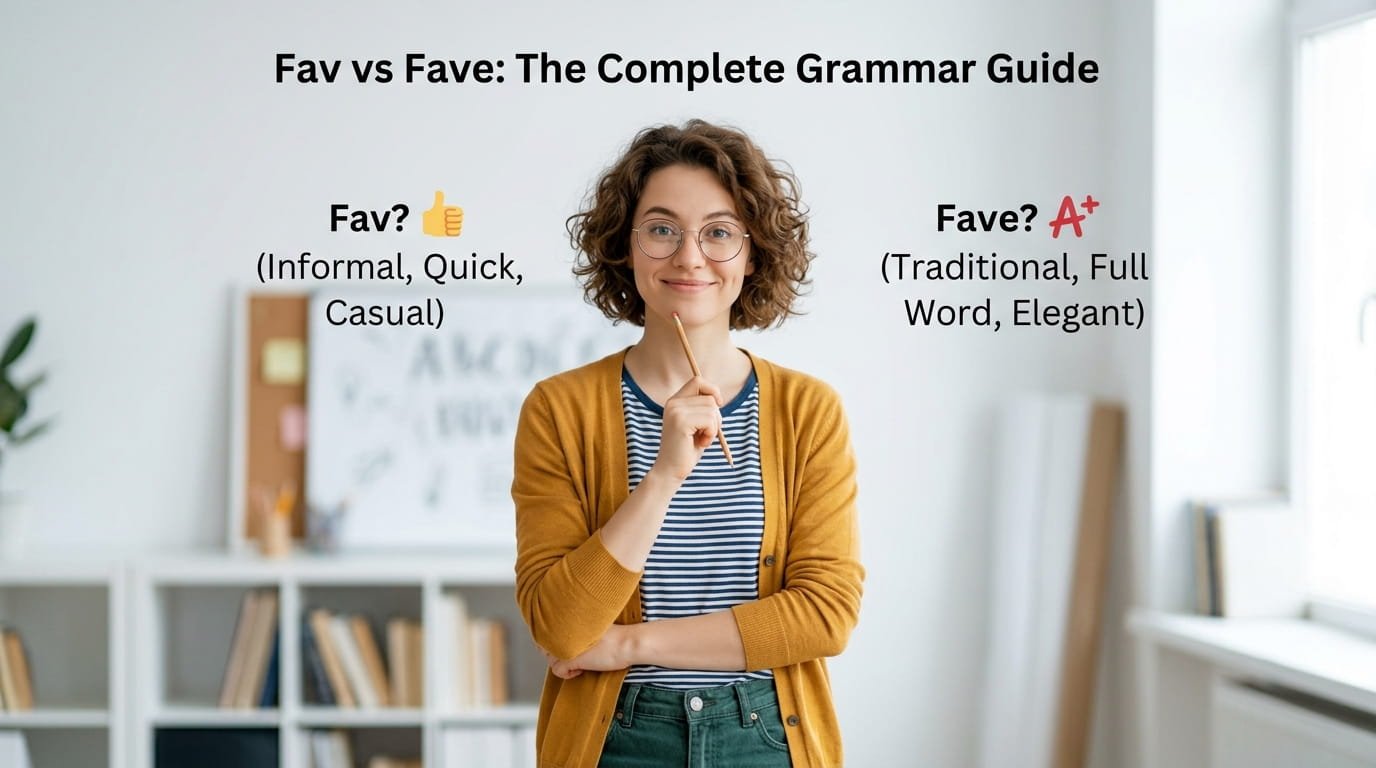
The meaning never changes between the two — both simply mean “favorite.” What changes is how each one feels in context. Many usage guides summarize it this way: fave reads more like a complete, finished word that fits naturally inside a sentence, while fav reads more like compressed shorthand built for speed — texting, hashtags, and interface design.
Grammar Rules: Noun, Adjective, and Plural Forms
As a noun
- Fav: “Pizza is my fav.” / “Add this to your favs.”
- Fave: “Pizza is my fave.” / “Add this to your faves.”
Both are grammatically interchangeable as nouns. The choice is stylistic, not grammatical.
As an adjective
- Fav: “my fav song,” “my fav color,” “my fav person”
- Fave: “my fave song,” “my fave color,” “my fave person”
Again, no grammatical distinction — only tone changes slightly.
Plural forms: favs vs faves
This is one area where usage patterns diverge a little more clearly. “Faves” is the more widely used plural across casual writing — “these are all my faves,” “top 5 faves of the week,” “all my faves in one place.” “Favs” appears more often in compressed, UI-style contexts — hashtags, app labels, or lists where brevity matters (e.g., a “Favs” tab in an app, as opposed to a “Faves” tab, though both exist depending on the platform’s style guide).
Repetition for emphasis (“fav fav fav”)
In very casual social captions, you’ll sometimes see a word simply repeated for emphasis — “fav fav fav” — functioning almost like an exclamation rather than a grammatical structure. This is purely stylistic internet shorthand and has no formal grammar rule attached to it; it is the written equivalent of enthusiastic repetition in speech.
When to Use Each One
A simple decision rule that usage guides consistently agree on:
- Use “favorite” (or “favourite” in UK English) in any formal, academic, professional, or client-facing writing. Neither fav nor fave belongs in a resume, report, essay, or business email.
- Use “fave” when writing in full, casual sentences — captions, texts, blog posts, comments — because it reads more smoothly and feels closer to spoken English.
- Use “fav” when space or speed matters most — hashtags, app buttons, UI labels, quick texts, or anywhere brevity outweighs polish.
- Avoid mixing both spellings within the same piece of writing. Consistency matters even in informal content; switching between fav and fave in the same paragraph looks careless rather than casual.
Fav and Fave Across Different Platforms
Social media and “favoriting”
The word fav is historically tied to the early social-media practice of “favoriting” content — most famously Twitter’s old star icon. Phrases like “save the fav” circulated when Twitter replaced the star with a heart-shaped “like” button, a change that sparked visible pushback from long-time users who associated fav with a specific, familiar action rather than a generic “like.” This history is part of why fav still feels more tied to interfaces than fave does.
Browsers and “fav icon”
Outside of the “favorite word” context, fav also shows up as a shortened reference to the favicon — the small icon shown in a browser tab — and in instructions like “how to add a fav in Safari,” which usually refers to adding a page to Safari’s Favorites list (via the Share menu, or the Bookmarks/Favorites sidebar). This is a related but technically separate use of the word: it’s a clipped reference to “Favorites” the browser feature, not a casual adjective describing personal preference.
Branding and menu names
Businesses frequently use fave(s) as a friendly, approachable word in marketing copy — for example, limited-time promotional menus branded around the idea of customer “faves,” or entertainment and streaming services naming a section “Faves” instead of “Favorites” to sound warmer and less formal. This branding trend leans almost entirely toward fave/faves rather than fav, because the goal is usually to sound conversational and friendly rather than compressed.
International and translation contexts
Because fav and fave are English slang, they don’t have direct one-word equivalents in other languages the way “favorite” does (for example, favorito/a in Spanish). When translating or writing bilingual content, it’s more accurate to translate the full word favorite rather than trying to translate the informal abbreviation itself, since fav/fave carry a casual, internet-native tone that doesn’t map cleanly across languages.
Common Mistakes to Avoid
- Using fav or fave in formal writing. Always replace with “favorite” (or “favourite”) in professional, academic, or client-facing content.
- Mixing spellings inconsistently. Pick one form per piece of writing and stick with it.
- Assuming one spelling is “wrong.” Neither is incorrect — dictionaries recognize both as informal variants, so the choice is about tone and audience, not correctness.
- Forgetting the plural pattern. It’s “favs” or “faves,” never “favies” or “favvies.”
- Confusing the abbreviation with unrelated similar-sounding words — covered next.
Words That Sound Similar But Aren’t Related
Because fav and fave are short, they overlap in spelling with several completely unrelated words and proper nouns. It’s worth separating these clearly, since they often appear in the same searches but mean something entirely different.
Fava beans
Fava (as in fava beans, also called broad beans) is an unrelated food term with no connection to “favorite.” Fava beans are a legume popular in Mediterranean, Middle Eastern, and North African cooking — used in dishes like ful medames, roasted as a snack, or dried for long-term storage. Recipes for fava bean dishes, tips on how to cook fava beans, information on fava bean nutrition and benefits, and even fava bean plant/seed growing guides are all part of a completely separate topic from the “fav vs fave” abbreviation discussion, despite the near-identical spelling. The famous line about “fava beans and a nice Chianti” from The Silence of the Lambs is likely one reason the word “fava” is so widely searched alongside “fav.”
Proper nouns and place names
Similar-looking words also appear as names, which is another unrelated category: surnames (such as Favara), restaurant names built around the word (an Italian ristorante, a bistro, a pizzeria, or a café using “Fav,” “Fava,” or “Favo” as a brand name), and place names like a state park whose name is spelled similarly but pronounced and used completely differently. None of these are abbreviations of “favorite” — they’re simply proper nouns that happen to share a similar spelling.
Brand and media names
Some businesses and media brands use “Fave” as part of their actual name rather than as an abbreviation — for instance, a now-discontinued TV channel that used “Fave” as its brand name, or limited-time restaurant promotions and product lines that use “Faves” as a proper marketing term rather than casual slang. When a channel, menu, or product line shuts down or changes, headlines about it are talking about a business/brand event — not about the grammar of the word “favorite.”
The takeaway: if the topic involves food, a business name, a place, or a person’s surname, it’s a different word entirely — not a variant of fav/fave. If the topic is about expressing personal preference (“my fav,” “my fave,” “all my faves”), that’s the informal abbreviation this guide covers.
Fav and Fave in Pop Culture and Everyday Language
Because both words are so flexible, they show up constantly in casual pop-culture conversation, and the pattern from earlier holds: fave tends to appear in full-sentence, personal-voice contexts, while fav leans toward tags, labels, and quick references.
- Naming a favorite thing directly: “my fav movie,” “my fave song,” “my fav quotation,” “my fave pokemon,” “these are all my fav xmas songs.” In every one of these, either spelling works — the sentence structure doesn’t change, only the tone.
- Titles and album names: Some artists and creators have leaned into the word directly — for instance, an album title built around the phrase “fave worst nightmare” plays on the word’s casual, personal-preference meaning. Similarly, a film title built around “my fav martian” uses the word as a stylistic, friendly nickname rather than strict grammar.
- Fandom and identity language: Communities built around shared interests (music fandoms, movie fandoms, aesthetic communities) often use “fav” or “fave” as a badge of personal identity — “my fav,” “my fave,” “all my favs,” “all ur favs” — to describe the specific artist, character, or creator someone is most attached to. This usage is entirely informal and community-driven rather than governed by any grammar rule; the spelling choice usually just follows whatever a particular community or platform trend has normalized.
- Comparisons and rankings: Phrases like “fans vs faves” or debates about “who’s your fav” are common in entertainment and fan communities, where people rank or compare artists, shows, or characters. Here, “fave” is almost always the noun form used in a sentence (“she’s a fan favorite” vs. “she’s my fave”), while “fav” shows up more in short-form polls, hashtags, and voting prompts.
- AI and digital trend content: Newer internet trends — like AI-generated image or content “swaps” built around a person’s stated favorites — also lean on this word casually, treating “fave” or “fav” as shorthand for whatever a user names as their top pick in a given category.
None of these pop-culture uses change the underlying grammar rule from earlier in this guide: both words still mean “favorite,” and the spelling choice is about rhythm and tone, not correctness.
A Short Timeline of the Two Words
| Period | Development |
|---|---|
| Latin/Old French era | Favor → favorit → favorito, ancestor of “favorite” |
| Pre-20th century | Full word “favorite/favourite” used exclusively; no abbreviations in common use |
| 1935 | Fav documented in horse racing writing, describing the projected race winner |
| 1938 | Fave documented in Variety magazine, used in show-business writing |
| Mid-20th century | Fave spreads into entertainment journalism and general slang |
| 2000s–2010s | Both words explode in use with texting and early social media, especially Twitter’s “favoriting” feature |
| Today | Both are standard informal English, recognized by major dictionaries, used interchangeably online and in branding |
A Quick Reference Cheat Sheet
- Writing a formal document? → “favorite” (US) or “favourite” (UK)
- Writing a full casual sentence? → “fave” usually reads smoother
- Labeling a button, tag, or hashtag? → “fav” usually fits the space better
- Talking about more than one? → “faves” is the more common plural, “favs” shows up more in UI contexts
- Referring to a browser’s saved pages or a favicon? → “fav” is used as shorthand, but it’s a different, technical usage
- Talking about food, a restaurant, a park, or someone’s surname that looks similar? → You’re likely dealing with “fava” or a proper noun, not the “favorite” abbreviation at all
Frequently Asked Questions
What does “fav” mean? Fav is an informal abbreviation of “favorite,” used as both a noun and an adjective — for example, “my fav song” or “add to fav.”
What does “fave” mean? Fave is the other common informal abbreviation of “favorite,” generally considered more natural inside full sentences — for example, “this is my fave.”
Is “fav” or “fave” more correct? Neither is more “correct” — both are informal and both are recognized in dictionaries. The choice depends on context: fave for sentences, fav for compressed labels and tags.
Can I use fav or fave in formal writing? No. Formal, academic, and professional writing should always use “favorite” (or “favourite” in British English) in full.
What’s the plural — favs or faves? Both exist, but “faves” is the more common plural in everyday writing (“all my faves”), while “favs” appears more often in app/UI contexts.
Why do people say “fav” for a favicon or browser favorites? This is a separate, technical shorthand — “fav” here refers to the browser’s Favorites feature or the small “favicon” shown in a tab, not to personal preference slang.
Is “fava” related to “fav” or “fave”? No. Fava, as in fava beans, is an unrelated food word with a different origin. It only looks similar in spelling.
Which is more popular — fav or fave? Search and usage trends generally show fave used somewhat more often in natural sentence writing, while fav remains dominant in interface design and hashtags.
Is “favo” the same as “fav” or “fave”? “Favo” isn’t a standard abbreviation of “favorite” — where it appears, it’s typically part of a brand or business name rather than casual slang, so it should be treated as a proper noun, not a grammar variant.
How do I say “fav” in Spanish? Spanish doesn’t have a direct slang equivalent — the closest translation is the full word favorito (masculine) or favorita (feminine), since fav/fave are English-specific informal clippings.
Can “fav” or “fave” describe a person, like “my fav person”? Yes — both are commonly used to describe a favorite person in casual, personal writing (“she’s my fave,” “he’s my fav person”), the same way they’re used for songs, movies, or colors. The grammar doesn’t change based on what’s being described.
Is it “fav colour” or “fave colour”? Both are used the same way “favorite color” is used — as an adjective before the noun. Either spelling is acceptable informally; consistency within your own writing matters more than which one you pick.
Conclusion
Fav and fave mean exactly the same thing — both are casual, dictionary-recognized shortenings of favorite — so there is no “wrong” choice between them. The real decision comes down to fit: fave reads more naturally in full sentences and friendly, conversational writing, while fav suits compressed spaces like app buttons, tags, and quick texts. Keep both out of formal writing, stay consistent within a single piece of content, and don’t confuse either one with unrelated lookalikes like fava beans or brand and place names that merely share similar spelling. Once you know the pattern, choosing between fav and fave stops being a guessing game and becomes a simple matter of tone.