Adjectives vs Adjactives: What Is an Adjective and Why “Adjactives” Isn’t a Real Word
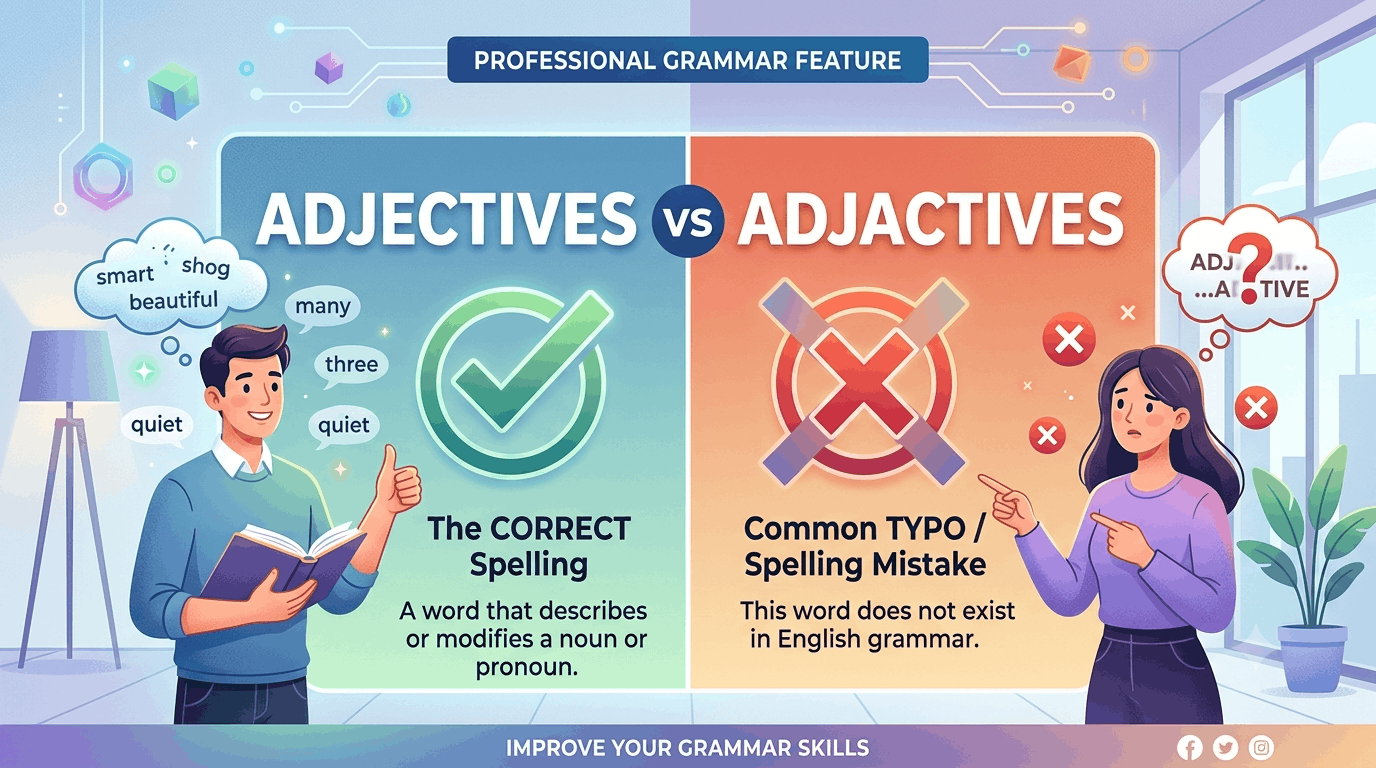
If you’ve ever typed “adjactive” or “adjactives” into a search bar, you’re not alone. Thousands of people search for adjactive, adjact, adjactive meaning, and even oddly specific phrases like adjact angles or adjactent sides every month. The truth is simple: “adjactive” is a common misspelling of “adjective.” There is no separate grammar term called an “adjactive” — it’s just a typo, a mishearing, or an autocorrect slip that has become so common it now has its own search traffic.
This article clears up the confusion once and for all. We’ll cover what an adjective actually is, how it’s used, the different types of adjectives, adjective order rules, adjectives in Spanish, adjectives vs adverbs, and long lists of adjectives organized by letter and by use-case — from adjectives to describe a person to positive and negative adjectives you can use in everyday writing.
Adjectives vs Adjactives: Clearing Up the Confusion
Let’s start with the core question: is it “adjective” or “adjactive”?
The correct spelling is adjective. “Adjactive” is not recognized by any major dictionary, style guide, or grammar authority. It appears to be a mix-up caused by:
- Mishearing the word — “adjective” said quickly can sound like it has an “a” sound in the middle.
- Confusion with “adjacent” — a completely different word meaning “next to” or “touching” (as in “adjacent angles,” which is likely why people search for things like “adjact angles” or “adjactent sides” and “adjactent and supplementary angles”). Adjacent is a geometry term describing two angles or sides that share a common point or edge — it has nothing to do with grammar.
- Autocorrect and typing errors on mobile keyboards, where “adjective” gets mistyped as “adjactive.”
So whenever you see “adjactive,” “adjact,” “adjacten,” or “adjactent” used in a grammar context, mentally replace it with adjective. If you’re dealing with angles, triangles, or geometry, the word you actually want is adjacent (as in adjacent angles, adjacent sides of a shape, or adjacent office buildings meaning buildings located next to each other).
With that cleared up, let’s dive into the real topic: adjectives.
What Is an Adjective? (Adjective Definition)
Adjective meaning: An adjective is a word that describes, modifies, or gives more information about a noun or pronoun. Adjectives tell us what kind, how many, which one, or whose something is.
In simple terms, the definition of adjective is: a describing word that adds detail to a person, place, thing, or idea.
For example:
- “The tall building” — tall describes the building.
- “She has three cats” — three tells us how many.
- “That is my phone” — my tells us whose it is.
- “This is the best restaurant in town” — best tells us which one, in a comparative sense.
So when someone asks “what is an adjective?” or “what’s an adjective?” — the short answer is: it’s a word that adds description or detail to a noun.
Adjective Examples
Understanding a definition is easier with real adjective examples. Here are some common ones grouped by what they describe:
Size: big, small, tiny, huge, enormous, massive, compact Color: red, blue, green, golden, colorful, dark, bright Shape: round, square, curved, flat, oval Age: young, old, ancient, new, modern, elderly Feeling/Emotion: happy, sad, angry, excited, nervous, calm Quality: good, bad, excellent, terrible, amazing, wonderful
A simple sentence example using an adjective: “The excited puppy ran across the green field toward its happy owner.” Here, excited, green, and happy are all adjectives, each modifying a different noun.
Adjective + Adjective: Using Multiple Adjectives Together
A common question is how to use adjective + adjective in a single sentence — meaning, how do you correctly stack more than one adjective before a noun?
For example: “She wore a beautiful, elegant dress.” Or: “It was a small, old, wooden table.”
When you use more than one adjective before a noun, English follows a specific order of adjectives, which we’ll explain in the next section. Skipping this order — for instance, saying “wooden old small table” instead of “small old wooden table” — sounds unnatural to native speakers, even though every word is grammatically correct on its own.
An adjective + adjective example with a comma: “It was a long, exhausting journey.” Notice the comma between two adjectives of a similar category (both describing the same general quality of the journey).
Order of Adjectives (Adjective Order)
English has an unwritten but consistent rule for adjective order when stacking multiple adjectives before a noun. The typical order is:
- Quantity or number (three, several, few)
- Opinion (beautiful, ugly, delicious)
- Size (big, small, tiny)
- Age (old, young, new)
- Shape (round, square)
- Color (red, blue)
- Origin (French, American)
- Material (wooden, plastic, cotton)
- Purpose/Qualifier (sleeping bag, running shoes)
Example: “She bought three beautiful small old round French wooden boxes.” While no one uses all nine categories at once in casual writing, this order explains why “a big red barn” sounds correct but “a red big barn” sounds off.
Types of Adjectives
There isn’t just one kind of adjective. Grammarians classify adjectives into several types, each serving a different function.
1. Descriptive Adjectives
These are the most common type and describe qualities like size, color, or feeling — e.g., tall, blue, happy, loud.
2. Quantitative Adjectives
These tell us “how much” or “how many” — e.g., some, many, few, several, all, no.
3. Demonstrative Adjectives
These point to specific nouns — this, that, these, those. Example: “I like this book but not those magazines.”
4. Possessive Adjectives
These show ownership — my, your, his, her, its, our, their. Example: “Her car is parked outside.”
5. Interrogative Adjectives
These are used to ask questions — which, what, whose. Example: “Which shirt do you want?”
6. Comparative and Superlative Adjectives
Comparative adjectives compare two things (bigger, faster, more interesting), while superlative adjectives compare three or more (biggest, fastest, most interesting).
7. Predicate Adjectives
A predicate adjective comes after a linking verb (like “is,” “was,” “seems,” “became”) rather than directly before the noun it describes. Example: “The sky is blue.” Here, “blue” is a predicate adjective describing “sky,” but it appears after the verb “is,” not directly before “sky.” Compare this to an attributive adjective: “The blue sky” — same word, different position.
8. Compound Adjectives
These are made of two or more words joined together (often with a hyphen) acting as a single adjective, e.g., “a well-known author,” “a five-year-old child.”
Positive and Negative Adjectives
Adjectives can also be grouped by tone — whether they express something favorable or unfavorable.
Positive adjectives describe good qualities and are useful for compliments, reviews, and resumes: kind, generous, brilliant, reliable, cheerful, confident, patient, wise, honest, talented.
Negative adjectives describe unfavorable qualities, often used in critical writing or to express dissatisfaction: rude, lazy, selfish, arrogant, dishonest, careless, stubborn, cruel, bitter, harsh.
Choosing the right tone of adjective can completely change how a sentence feels. “She is determined” (positive) reads very differently from “She is stubborn” (negative) — even though both can describe the same underlying trait.
Adjectives to Describe a Person, Yourself, or a Character
One of the most practical uses of adjectives is describing people — whether it’s someone else, yourself in a bio or interview, or a character in a story.
Adjectives to describe a person (general traits): friendly, intelligent, hardworking, honest, ambitious, humble, generous, thoughtful, energetic, dependable.
Adjectives to describe yourself (useful for resumes, dating profiles, or interviews): driven, adaptable, curious, resourceful, disciplined, empathetic, confident, organized, creative, resilient.
Adjectives that explain a person’s personality: outgoing, introverted, optimistic, pessimistic, analytical, spontaneous, cautious, sociable, independent, sensitive.
Adjectives to describe a character (for creative writing): mysterious, courageous, cunning, loyal, ruthless, gentle, eccentric, stoic, charismatic, vengeful.
If you’re writing a bio, a dating profile, or a mission statement, mixing a couple of positive adjectives with concrete examples tends to sound far more genuine than a long list of adjectives stacked together.
List of Adjectives by Starting Letter
Many people search for adjectives that start with a specific letter — often for word games, vocabulary building, or writing exercises. Here’s a practical list organized alphabetically.
- A: amazing, adventurous, ambitious, artistic, agile, awkward
- B: brave, bright, bold, beautiful, busy, brilliant
- C: calm, curious, confident, careful, cheerful, clever
- D: determined, delightful, daring, diligent, dependable
- E: energetic, elegant, eager, extraordinary, efficient
- F: friendly, funny, fierce, faithful, flexible
- G: generous, gentle, graceful, genuine, glamorous
- H: honest, humble, happy, hardworking, harmonious
- I: intelligent, imaginative, independent, inventive
- J: joyful, jovial, judicious
- K: kind, keen, knowledgeable
- L: loyal, lively, logical, luminous
- M: modest, motivated, mysterious, meticulous
- N: nurturing, neat, notable
- O: optimistic, observant, organized, outgoing
- P: patient, passionate, practical, playful
- R: reliable, resourceful, resilient, respectful
- S: sincere, sociable, strong, supportive
- T: thoughtful, tenacious, trustworthy
- V: vibrant, versatile, vigilant
- W: wise, warm, witty, welcoming
- Y: youthful (used descriptively; fewer common adjectives start with this letter)
This kind of list is useful for vocabulary practice, creative writing prompts, or simply expanding your everyday word choices beyond common adjectives like “nice” or “good.”
Adjectives vs Adverbs
Another frequent point of confusion is the difference between adjectives and adverbs. While both are descriptive words, they modify different things:
- Adjectives modify nouns and pronouns (a quick runner).
- Adverbs modify verbs, adjectives, or other adverbs, and often end in “-ly” (she runs quickly).
A simple test: if the word is describing a person, place, or thing, it’s likely an adjective. If it’s describing how an action is performed, it’s likely an adverb. Example: “The quiet child spoke quietly.” Quiet (adjective) describes the child; quietly (adverb) describes how she spoke.
Adjectives in Spanish
For language learners, Spanish adjectives work a bit differently from English ones. Two key differences:
- Agreement: Spanish adjectives must agree in gender (masculine/feminine) and number (singular/plural) with the noun they describe. For example, “tall” becomes “alto” for a masculine singular noun, “alta” for feminine singular, “altos” for masculine plural, and “altas” for feminine plural.
- Position: Unlike English, many Spanish adjectives come after the noun rather than before it. For example, “the red car” becomes “el coche rojo” — literally “the car red.”
Possessive adjectives in Spanish also change based on gender and number: mi (my), tu (your), su (his/her/their), nuestro/nuestra (our). Example: “mi casa” (my house) vs. “nuestros amigos” (our friends).
Why the “Adjective vs Adjective” Search Confusion Happens
Interestingly, some people also search phrases like “adjective and adjective” or “adjectives and adjectives” — which usually means they’re looking for how two adjectives work together in a sentence, or simply searching the word twice out of habit while looking for a definition. If that’s what brought you here, the answer is the same as above: when two adjectives appear together, they either work as a coordinate pair separated by a comma (“a quiet, peaceful evening”) or as a cumulative pair without a comma, following the standard adjective order (“a quiet little town”). The difference between coordinate and cumulative adjectives comes down to a simple test — if you can swap the order of the two adjectives or insert “and” between them without it sounding strange, they’re coordinate adjectives and need a comma. If swapping them sounds wrong, they’re cumulative and don’t need a comma.
For example: “a peaceful, quiet evening” and “a quiet, peaceful evening” both sound fine, so a comma is needed. But “quiet little town” cannot be flipped to “little quiet town” without sounding off, so no comma is used.
Adjectives in Job Descriptions and Mission Statements
Adjectives aren’t just for creative writing — they play a big role in professional contexts too. A well-written mission statement, for instance, often leans on a small set of carefully chosen adjectives to define an organization’s identity: words like “innovative,” “sustainable,” “inclusive,” “reliable,” or “customer-focused” appear again and again because they instantly communicate values without needing a full sentence of explanation.
The same applies to job postings and performance reviews. Recruiters often scan resumes for adjectives like “proactive,” “detail-oriented,” “collaborative,” and “results-driven” because these words compress a lot of meaning into a single term. The key is not to overload a sentence with adjectives — one or two well-chosen, specific adjectives, backed up by an example or achievement, are far more convincing than a long stacked list.
Adjectives That Describe Places, Objects, and Abstract Ideas
While a lot of adjective use centers on people, adjectives are just as important for describing places, objects, weather, and even abstract concepts.
Adjectives for places: scenic, remote, bustling, historic, picturesque, coastal, rural, urban, tranquil, vibrant.
Adjectives for objects: sturdy, fragile, sleek, compact, durable, lightweight, polished, worn, intricate.
Adjectives for weather: humid, breezy, freezing, scorching, mild, stormy, overcast, crisp.
Adjectives for abstract ideas (e.g., a deadline, a problem, an initiative): urgent, ambitious, complex, straightforward, pressing, achievable, overdue, well-defined. For example, someone might describe a project deadline as “tight” or “flexible,” or describe an initiative at work as “ambitious” or “forward-thinking.” These abstract adjectives are especially useful in business writing, project updates, and planning documents, where you need to convey tone and urgency without lengthy explanations.
How to Choose the Right Adjective
With so many adjectives available, choosing the most precise one can make writing far more effective. Here are a few practical tips:
- Be specific instead of generic. Instead of “good,” consider whether you mean “impressive,” “reliable,” “enjoyable,” or “well-made” — each carries a slightly different shade of meaning.
- Match the tone to the context. A resume calls for professional adjectives like “diligent” or “resourceful,” while a casual story might use more playful ones like “goofy” or “quirky.”
- Avoid overloading a sentence. Two or three well-placed adjectives are usually more powerful than five or six stacked together, which can make writing feel cluttered.
- Use adjectives that show, not just tell. Instead of just saying someone is “nice,” pairing it with a specific adjective like “attentive” or “considerate” paints a clearer picture.
- Watch out for overused adjectives. Words like “nice,” “good,” and “bad” are so common they lose impact. Swapping them for more precise alternatives instantly improves the quality of writing.
Common Adjective Mistakes to Avoid
Even confident English speakers sometimes misuse adjectives. Here are frequent mistakes:
- Using an adverb instead of an adjective (or vice versa): “She feels badly” should be “She feels bad,” since “feels” is a linking verb requiring a predicate adjective, not an adverb.
- Double comparatives/superlatives: “more better” or “most best” are incorrect — just say “better” or “best.”
- Wrong adjective order: Saying “a leather brown old jacket” instead of “an old brown leather jacket” breaks the natural adjective order native speakers expect.
- Confusing “adjective” with “adjacent”: As covered earlier, these are unrelated words — one is a grammar term, the other describes physical closeness (as in adjacent angles or adjacent buildings).
Adjectives in Everyday Conversation vs Formal Writing
The adjectives we reach for often shift depending on whether we’re speaking casually or writing formally. In casual conversation, people tend to use simple, high-frequency adjectives — “cool,” “awesome,” “weird,” “boring” — because speed and relatability matter more than precision. In formal writing, such as essays, reports, or professional emails, more specific and measured adjectives tend to work better: “innovative” instead of “cool,” “unconventional” instead of “weird,” “monotonous” instead of “boring.”
This doesn’t mean casual adjectives are wrong — context is everything. A text message to a friend that reads “that movie was awesome” fits perfectly, while a film review for a publication might instead call the same movie “gripping” or “visually stunning” to sound more polished and specific.
Building Your Own Adjective Vocabulary
If you’re a student, a writer, or simply someone trying to expand your vocabulary, building a personal list of adjectives is one of the most effective habits you can develop. A few practical approaches:
- Keep a running list of new adjectives you come across while reading, grouped by category (personality, emotion, appearance, weather, etc.).
- Practice synonyms. For every common adjective you use often — like “good,” “bad,” “nice,” or “big” — try to note down three or four stronger alternatives.
- Read widely. Fiction, journalism, and even product reviews are packed with adjectives used in context, which is a far more natural way to learn them than memorizing isolated word lists.
- Use adjectives in sentences, not isolation. Simply memorizing a list of adjectives that start with a certain letter is useful for games or quizzes, but true fluency comes from using each word in a real sentence until it feels natural.
Over time, this kind of practice naturally reduces reliance on repetitive, generic adjectives and replaces them with more precise, descriptive language — whether you’re writing a story, a school assignment, or a professional bio.
Quick Reference: Adjective FAQs
What is an adjective? A word that describes or modifies a noun or pronoun, giving more detail about qualities like size, color, number, or feeling.
What is a predicate adjective? An adjective that follows a linking verb (is, was, seems, becomes) rather than sitting directly before the noun, e.g., “The soup tastes delicious.”
Is “adjactive” a real word? No. It’s a common misspelling of “adjective.” If you’re searching for “adjact,” “adjactent,” or “adjactive meaning,” the word you’re actually looking for is either “adjective” (grammar) or “adjacent” (geometry/proximity).
What’s the difference between an adjective and an adverb? Adjectives describe nouns and pronouns; adverbs describe verbs, adjectives, or other adverbs, and often end in “-ly.”
Can you give some examples of adjectives? Yes — common examples include happy, tall, blue, three, delicious, ancient, and brave, among thousands of others across categories like size, color, quantity, and emotion.
Conclusion
To sum up: adjectives are describing words that add detail to nouns and pronouns, while “adjactives” is simply a misspelling with no grammatical meaning of its own — often confused with the geometry term “adjacent.” Once you understand the real definition of an adjective, the different types (descriptive, possessive, demonstrative, predicate, comparative, and more), and rules like adjective order, using them correctly becomes second nature.
Whether you’re building a vocabulary list, describing yourself for a resume, learning Spanish adjectives, or just trying to spell the word correctly, remember: it’s adjective, not “adjactive” — and now you know exactly how to use one.