Affect vs Effect: The Complete Guide with Rules, Examples, Tricks, and a Quiz
If you have ever paused mid-sentence wondering whether to write “the weather affects my mood” or “the weather has an effect on my mood,” you are not alone. The affect vs effect confusion is one of the most common grammar mix-ups in the English language, and it trips up native speakers and learners alike. Even professional writers occasionally have to stop and double-check.
This guide breaks down everything you need to know: the core definitions, the grammar rules, memory tricks, every possible word form (affected vs effected, affects vs effects, affecting vs effecting, affective vs effective), real sentence examples, and a quiz so you can test yourself at the end. By the time you finish reading, you will never have to guess again.
Define Affect vs Effect: The Basic Meaning
Let’s start with a simple definition of affect vs effect before we go deeper into grammar rules.
- Affect (verb) means “to influence” or “to have an impact on something.”
- Effect (noun) means “a result” or “the outcome of an action.”
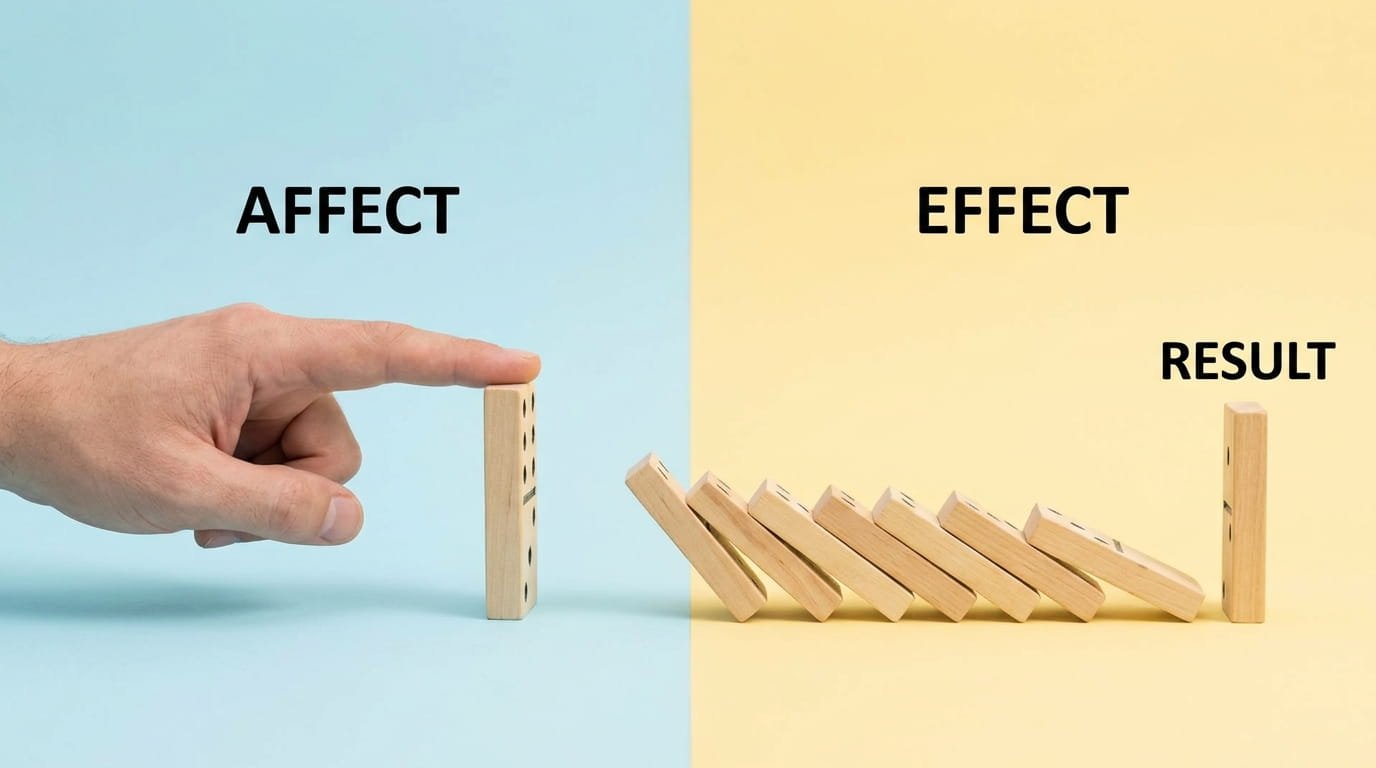
So, in the simplest possible terms: affect is the action, and effect is the result of that action.
Example:
- The new policy will affect small businesses. (It will influence them.)
- The new policy will have a major effect on small businesses. (This is the result.)
This is the core of the affect vs effect meaning that most grammar guides teach, but as you will see later in this article, there are exceptions where affect can be a noun and effect can be a verb. We’ll cover those too.
Affect vs Effect Grammar Rules
Here are the foundational affect vs effect grammar rules that cover about 95% of real-world usage:
- Affect is usually a verb. It describes an action — something influencing something else.
- Effect is usually a noun. It describes a result, a thing that happened because of an action.
- Effect can occasionally be a verb, meaning “to bring about” or “to cause to happen” (e.g., “to effect change”).
- Affect can occasionally be a noun, used mostly in psychology to describe an observable emotional expression (e.g., “a flat affect”).
If you remember rule 1 and rule 2, you will get the affect vs effect difference right almost every time.
When to Use Affect vs Effect
Knowing when to use affect vs effect comes down to asking yourself one question: Am I describing an action, or am I describing a result?
- If you’re describing an action or influence → use affect (verb).
- If you’re describing a result or outcome → use effect (noun).
Try this test: replace the word with “influence” or “result.”
- “Lack of sleep can [influence] your focus.” → affects
- “Lack of sleep has a serious [result] on your focus.” → effect
This simple substitution trick works in almost every sentence and is one of the easiest ways to figure out how to use affect vs effect correctly without memorizing complicated rules.
Affect vs Effect Trick (Easy Memory Tricks)
If grammar rules feel too abstract, try one of these popular affect vs effect tricks:
The “RAVEN” Trick
Remember Affect Verb Effect Noun (RAVEN). Since a raven is a bird, and “A” comes before “E” in both the alphabet and in “Affect/Effect,” this acronym helps you recall that affect = verb and effect = noun.
The “A is for Action” Trick
- Affect starts with A, and so does Action. Affect is an action (verb).
- Effect starts with E, and so does End result. Effect is an end result (noun).
The Article Trick
If the word follows “an,” “the,” or another article, it’s almost always effect (since it’s a noun). For example: “the effect,” “an effect,” “a positive effect.”
Using any of these tricks consistently will make the affect vs effect checker in your head automatic within a few days of practice.
Affect vs Effect in a Sentence: Real Examples
Seeing affect vs effect examples in context is the fastest way to understand the difference. Here are several affect vs effect examples covering different situations:
Using affect (verb):
- Loud noises affect her concentration.
- The medication may affect your appetite.
- Climate change continues to affect coastal cities.
- His harsh comments affected the team’s morale.
- Will the exchange rate affect our travel budget?
Using effect (noun):
- The effect of the medicine wore off after six hours.
- Researchers studied the effect of sleep on memory.
- The new law had an immediate effect on the housing market.
- Her speech had a powerful effect on the audience.
- One side effect of the treatment is drowsiness.
Notice that in almost every case, affect is doing something (verb) while effect is a thing that exists (noun). This pattern holds for the overwhelming majority of everyday sentences.
Affected vs Effected
Now let’s look at the past tense forms, starting with affected vs effected.
- Affected = past tense of the verb “affect,” meaning something was influenced or impacted.
- Example: “The drought affected crop production across the region.”
- Effected = past tense of the verb “effect,” meaning something was brought about or caused to happen. This use is rare and mostly formal or legal in tone.
- Example: “The new CEO effected major changes within her first month.”
In everyday writing, you will use “affected” far more often. “Effected” appears mainly in formal, business, or legal writing when talking about implementing or causing a change.
There’s also a common adjective use of “affected,” meaning fake or pretentious (e.g., “he spoke in an affected accent”), which is a separate meaning worth knowing.
Affects vs Effects
The plural or third-person singular forms follow the same logic as affects vs effects:
- Affects = the verb form used with he/she/it (present tense).
- Example: “Stress affects the immune system.”
- Effects = the plural noun form, referring to multiple results or consequences.
- Example: “The effects of the storm were visible for weeks.”
A helpful way to remember effects vs affects: if you can put a number or “the” in front of it (like “three effects” or “the effects”), it’s the noun form, effects. If it’s describing what a singular subject does to something else, it’s affects.
Affecting vs Effecting
Moving to the -ing forms, affecting vs effecting works the same way:
- Affecting = present participle of “affect,” meaning currently influencing something. It can also function as an adjective meaning “emotionally moving.”
- Example: “The documentary was deeply affecting.”
- Example: “Rising fuel prices are affecting transportation costs.”
- Effecting = present participle of “effect,” meaning in the process of bringing something about. Again, this is rare and formal.
- Example: “The committee is effecting reforms to the tax code.”
If you’re ever unsure between affecting and effecting, remember that “affecting” is far more common in daily conversation, while “effecting” belongs almost exclusively to formal or bureaucratic writing.
Affective vs Effective
This pair often gets confused with affect vs effect, but affective vs effective are actually two separate adjectives with very different meanings.
- Affective relates to emotions, moods, or feelings. It’s a term used mostly in psychology.
- Example: “Seasonal affective disorder is linked to reduced sunlight in winter.”
- Effective means successful in producing the desired result.
- Example: “The new marketing strategy was highly effective.”
So while effective vs affective sound similar, “effective” is the word you’ll use 99% of the time in everyday writing (meaning “it works well”), and “affective” is a specialized term almost always tied to emotional or psychological contexts.
Effect vs Affect Verb Usage
A quick note on the effect vs affect verb question, since this confuses many learners: both words can technically function as verbs, but they mean completely different things.
- Affect (verb) = to influence something that already exists.
- Effect (verb) = to cause something new to happen or come into existence.
Compare:
- “The drug affects blood pressure.” (It changes an existing condition.)
- “The new manager effected a complete turnaround in sales.” (She caused a new outcome to exist.)
If you’re choosing between these two verb forms, ask: am I changing something that already exists (affect), or am I creating a brand-new result (effect)? This distinction is subtle but useful in professional and academic writing.
Affect vs Effect vs Impact
Many people also wonder how “impact” fits into the affect vs effect vs impact comparison.
- Impact can function as both a noun and a verb, and in modern usage, it is often used interchangeably with “affect” (verb) or “effect” (noun).
- As a verb: “The delay will impact our schedule.” (similar to “affect”)
- As a noun: “The impact of the decision was significant.” (similar to “effect”)
While some traditional grammar guides discourage using “impact” as a verb in formal writing, it has become widely accepted in business and everyday English. If you want to stay strictly traditional, use “affect” as the verb and “effect” or “impact” as the noun.
Common Mistakes: Affect vs Effect Checker Tips
Even careful writers slip up. Here’s a quick affect vs effect checker list to run through before you hit publish or submit:
- Did I use “affect” as a noun without meaning emotional expression? → Likely wrong; use “effect” instead.
- Did I use “effect” as a verb without meaning “to cause/implement”? → Likely wrong; use “affect” instead.
- Am I talking about a result? → Use effect.
- Am I talking about an influence in progress? → Use affect.
- Does the sentence use “an effect on” or “affects”? Both are usually correct patterns — double check which one fits your meaning.
Running your sentence through this checklist takes only a few seconds and eliminates almost every common error.
Affect vs Effect Quiz
Test your understanding with this short affect vs effect quiz. Choose the correct word for each sentence, then check the answers below.
- Poor lighting can ______ your ability to read for long periods.
- The medicine had an immediate ______ on her energy levels.
- New management ______ several changes to the workflow.
- Loud music in the office ______ everyone’s concentration.
- The economic downturn had a ripple ______ on local businesses.
- His tone of voice was oddly ______ (fake/pretentious).
- The therapy session was designed to improve his ______ disorder symptoms.
- She hopes her new diet will be ______ (successful) in lowering cholesterol.
Answers:
- affect
- effect
- effected
- affects
- effect
- affected
- affective
- effective
If you got most of these right, you have a solid grip on affect vs effect. If you missed a few, revisit the sections above on affected vs effected and affective vs effective.
Affect vs Effect Worksheet: Practice Sentences
Here’s a simple affect vs effect worksheet you can use for extra practice — fill in the blanks with the correct word (affect, effect, affects, effects, affected, effected, affecting, effecting, affective, or effective):
- The teacher’s feedback __________ my confidence in a positive way.
- Scientists are still studying the long-term __________ of microplastics on marine life.
- The company __________ major structural changes last quarter.
- Her calm presence has a soothing __________ on the whole team.
- Jet lag can __________ your sleep schedule for several days.
- The side __________ of the new medication include mild nausea.
- He gave an __________ (fake) laugh to be polite.
- The training program proved __________ (successful) at reducing workplace accidents.
Try writing your own five sentences using each form — affect, effect, affected, effected, affecting, effecting, affective, and effective — to reinforce the pattern. Practicing active recall like this is far more effective than simply reading rules.
Final Recap: Affect vs Effect Difference in One Line
If you remember nothing else from this article, remember this:
Affect is (usually) the verb — the action of influencing something. Effect is (usually) the noun — the result of that action.
Keep the RAVEN trick in mind (Remember Affect Verb, Effect Noun), watch out for the rare exceptions (affect as a noun in psychology, effect as a verb meaning “to bring about”), and don’t confuse affective (emotional) with effective (successful).
With the rules, tricks, examples, quiz, and worksheet in this guide, you now have everything you need to use affect and effect correctly — in essays, emails, reports, or everyday conversation — without ever second-guessing yourself again.